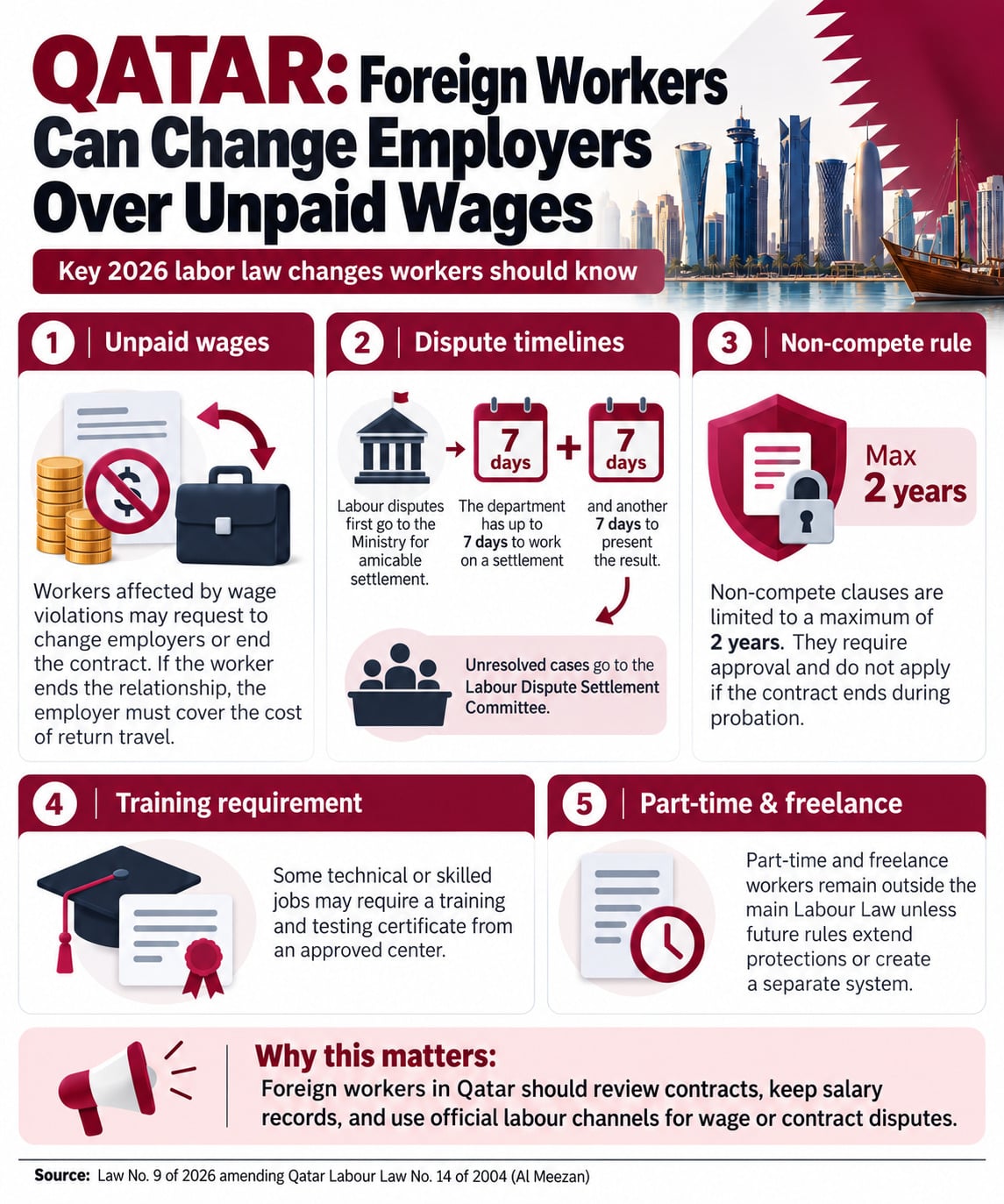
Workers in Qatar should be aware of several changes introduced under Law No. 9 of 2026, which amended parts of the country’s Labour Law.
The law was issued on June 11, 2026 and published in the Official Gazette on June 25. It updates rules covering labor disputes, employer violations, non-compete clauses, worker committees, recruitment, and selected professional requirements.

Workers Can Seek Job Change Over Unpaid Wages
One of the most useful changes affects workers whose employers violate wage-payment requirements.
Under the amended law, a worker affected by an employer’s violation of Article 66 may request to change employers or end the employment relationship.
If the worker chooses to end the relationship, the violating company must also cover the worker’s cost of returning home.
The Ministry of Labour may also suspend some transactions of companies that violate the law or repeatedly delay wages.
However, the suspension should not prevent workers from renewing their work permits or residence permits.
Labor Disputes Now Have Clearer Deadlines
The amended law also sets specific timelines for resolving employment disputes.
Workers and employers must first submit the dispute to the concerned Ministry of Labour department for an attempt at an amicable settlement.
The department has up to seven days to work on the settlement and another seven days to present the result.
If no agreement is reached, the case must then be referred to the Labour Dispute Settlement Committee within the specified period.
The law also allows the committee to use electronic systems after verifying the identity of the worker, employer, or witness.
Non-Compete Clauses Limited to Two Years
Employers can still include non-compete clauses when a worker has access to customers or business secrets.
However, the amended Article 43 states that the restriction cannot exceed two years.
The clause also requires approval from the concerned authority, and it does not apply if the employment contract ends during the probation period.
Some Jobs May Require Training Certificates
Another new provision allows certain technical or skilled occupations to require a training and testing certificate from an approved training center.
The Ministry of Labour will determine which occupations are covered and publish the approved list on its website.
What About Freelance and Part-Time Workers?
Law No. 9 of 2026 specifically lists part-time and freelance workers among the groups outside the main Labour Law.
However, the Council of Ministers may later apply some Labour Law provisions to these workers or introduce a separate employment system for them.
This means workers should not assume that freelance or part-time arrangements now receive all the same protections as standard employment.
What Workers Should Know
OFWs and other expats should review their employment contracts, keep salary records, and use official Ministry of Labour channels when facing wage or contract disputes.
Workers affected by unpaid wages or other employment violations should verify the current procedure before changing employers or ending their contract.